August 11, 2026
The Difference Between Ordinary Lamp Molds and Molds with Advanced Optical Design
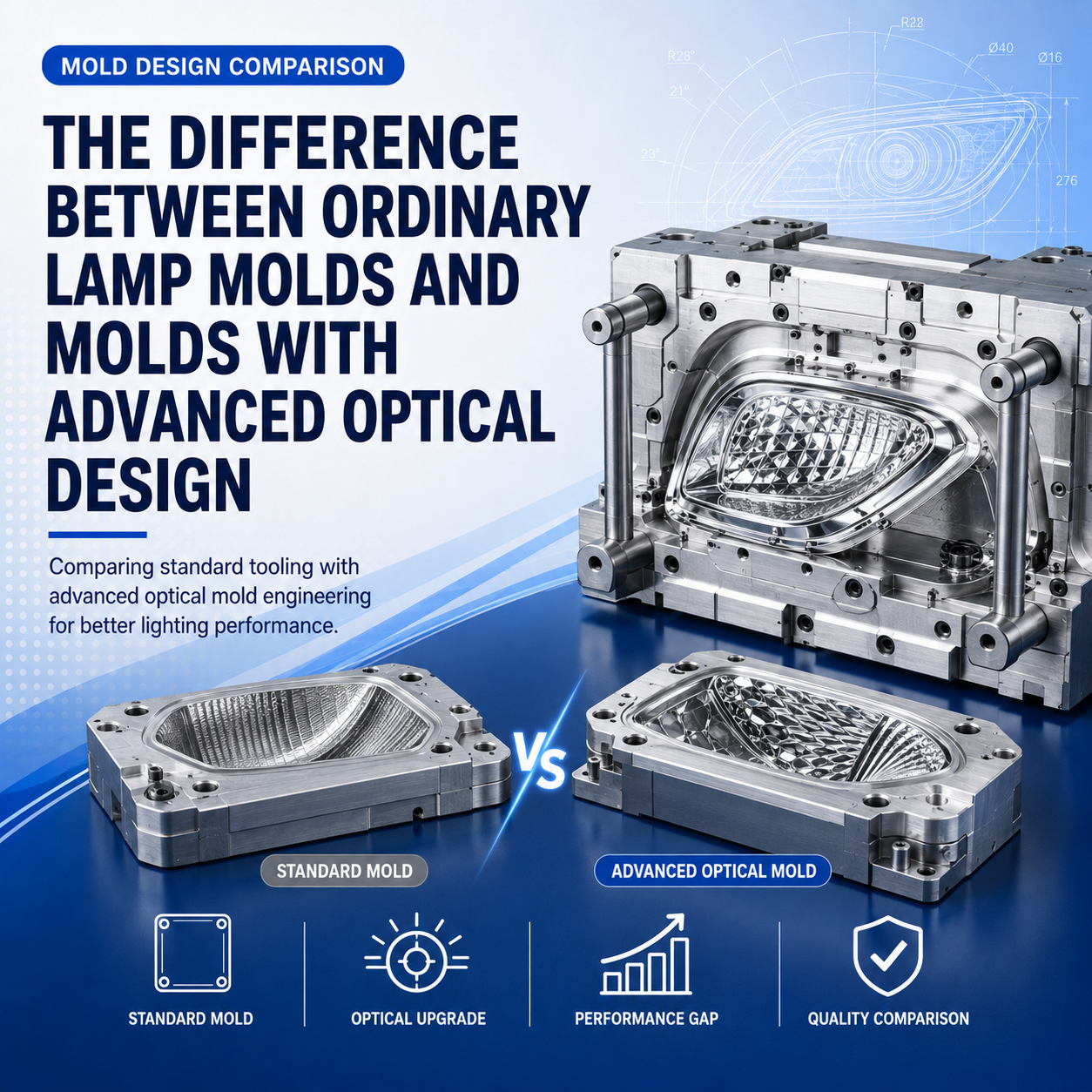
Table of Contents
1. Introduction
2. Core Definition of Two Types of Lamp Molds
3. Differences in Early Development Design
4. Differences in Machining & Surface Processing Standards
5. Differences in Product Optical Performance
6. Comparative Data Table of Practical Application Indicators
7. Differences in Mass Production Stability & Comprehensive Cost
8. How to Select Suitable Lamp Molds for Your Project
9. Conclusion
10. Industry FAQ
1. Introduction
Automotive lamp molds determine the appearance and lighting performance of finished lamps. Many buyers confuse ordinary lamp molds and molds equipped with advanced optical design at the procurement stage.
On the surface, two kinds of molds can produce lamp housings, reflectors and lenses. But gaps exist in design logic, processing precision and long-term use effect.
Ordinary lamp molds focus more on molding appearance and basic demolding requirements. Molds with advanced optical design take light path simulation, light distribution standard and optical micro-structure as core targets.
This article compares all dimensions of the two mold types, combines practical test data, and helps manufacturers and purchasers make clear judgments.
Core Industry Keywords: automotive lamp mold, ordinary lamp mould, advanced optical design, optical surface machining, light distribution performance, reflector mold, lens mold, automotive lighting component
2. Core Definition of Two Types of Lamp Molds
2.1 Ordinary Lamp Molds
Ordinary lamp molds mainly meet basic plastic forming demands. Designers only complete mold structure, gating system and cooling layout.
Optical curved surfaces are produced according to simple 2D sketches. No professional ray tracing simulation is carried out before machining.
This kind of mold is widely used in low-end lighting products with loose lighting parameter requirements.
2.2 Molds with Advanced Optical Design
Advanced optical design runs through the whole mold development cycle. Engineers build optical 3D models and complete light simulation at the initial stage.
All optical surfaces, micro-lens textures and reflector curved surfaces are optimized according to automotive lighting regulations.
The final mold structure, ejection position and polishing scheme are adjusted to match optical performance, not only to realize plastic forming.
3. Differences in Early Development Design
3.1 Design Focus
Ordinary lamp molds: Prioritize mold opening feasibility, avoid undercut, control basic shrinkage compensation. Optical performance is only verified after sample trial.
Molds with advanced optical design: Optical simulation precedes mold structure design. Light spot, uniformity and glare risk are checked in digital model phase.
3.2 Development Risk
Ordinary lamp molds. If lighting test fails after trial production, repeated mold modification is unavoidable. It brings uncertain project cycle.
Molds with advanced optical design. Most optical defects are eliminated in simulation stage. The frequency of large-scale rework is greatly reduced.
4. Differences in Machining & Surface Processing Standards
4.1 Precision Tolerance
Ordinary lamp molds adopt general mold tolerance. Local deviation of optical curved surface within 0.05mm is usually acceptable.
Molds with advanced optical design set strict tolerance below 0.02mm on key optical surfaces. Tiny deformation will affect light path output.
4.2 Polishing Requirements
Ordinary molds only require smooth surface without obvious scratches. No unified standard for optical texture continuity.
Optical design molds need graded ultra-precision polishing. The continuity of micro-structure must be maintained, and polishing direction is strictly limited.
5. Differences in Product Optical Performance
5.1 Light Uniformity
Lamps produced by ordinary molds easily form local bright spots and dark areas. The light transition looks unnatural.
Products from optical optimized molds achieve even light distribution. Soft transition meets visual requirements of passenger vehicles.
5.2 Regulation Compliance
A large number of samples from ordinary molds fail glare and illumination range tests. Secondary modification is needed to pass official certification.
Molds with advanced optical design are developed according to SAE and domestic lighting standards. The first sample has high possibility to pass parameter inspection.
6. Comparative Data Table of Practical Application Indicators
The table below collects real test data from automotive lighting mold projects.
表格
Inspection Item | Ordinary Lamp Molds | Molds with Advanced Optical Design | Industry Acceptance Standard |
Optical surface machining tolerance | ≤0.05 mm | ≤0.02 mm | — |
Light uniformity of finished lamp | 65% ~ 75% | 88% ~ 94% | ≥80% |
First trial optical qualification rate | 52% | 87% | — |
Average mold modification times | 3 ~ 7 times | 0 ~ 2 times | — |
Stable optical service shot | 60,000 ~ 90,000 shots | 120,000 ~ 160,000 shots | — |
Risk of glare exceeding standard | High | Low | Strict limit value |
The data clearly shows that molds supported by advanced optical design own obvious advantages in one-time success rate and long-term stability.
7. Differences in Mass Production Stability & Comprehensive Cost
Ordinary lamp molds have lower initial mold price. But frequent modification and batch product unqualified problems push up the overall project cost.
Molds with optical design have slightly higher upfront investment. They reduce rework expense and cut the rejection rate during mass production.
For medium and high-end vehicle projects, the comprehensive cost of optical optimized molds is more competitive in long term.
8. How to Select Suitable Lamp Molds for Your Project
Choose ordinary lamp molds if you produce low-speed vehicles, agricultural machinery lamps and products without strict light distribution certification.
If you supply passenger car, new energy vehicle lighting components, molds with advanced optical design are the preferred choice. Stable optical performance helps finish vehicle factory access audit smoothly.
You can ask mold suppliers to provide optical simulation report before project launch, to judge whether they carry out systematic optical design.
9. Conclusion
The essential gap between ordinary lamp molds and optical design molds is not machining accuracy alone, but the starting point of design thinking.
Ordinary molds take plastic forming as the core goal. Molds with advanced optical design regard qualified light distribution performance as the primary target.
With increasingly strict automotive lighting regulations, advanced optical design gradually becomes a standard configuration for mainstream automotive lamp mold development.
10. Industry FAQ
Q1: Can we upgrade ordinary lamp molds to reach optical design standards through later polishing? A: It is hard to realize. Many optical defects come from unreasonable curved surface design. Surface polishing only solves scratch problems and cannot adjust light path distribution.
Q2: How long will optical design extend the whole mold development cycle? A: Optical simulation takes 7~14 working days at early stage. But it avoids long-time modification after trial, the total cycle will not be prolonged, even shorter.
Q3: Do both reflector molds and lens molds need advanced optical design? A: Yes. Reflector depends on reflection path and lens uses refraction path. Both require independent optical simulation to avoid light defects.
Q4: Is advanced optical design only fit for LED automotive lamps? A: Mainly applied to LED lamps with high light control requirements. Halogen lamp products with simple structure can choose ordinary molds according to demands.
Q5: What documents should formal optical design mold suppliers provide? A: Optical simulation report, light distribution prediction chart, optical surface tolerance specification and sample lighting test data.