August 11, 2026
Precision Injection Molding for Automotive Lighting: What Makes a World-Class Auto Lamp Mold
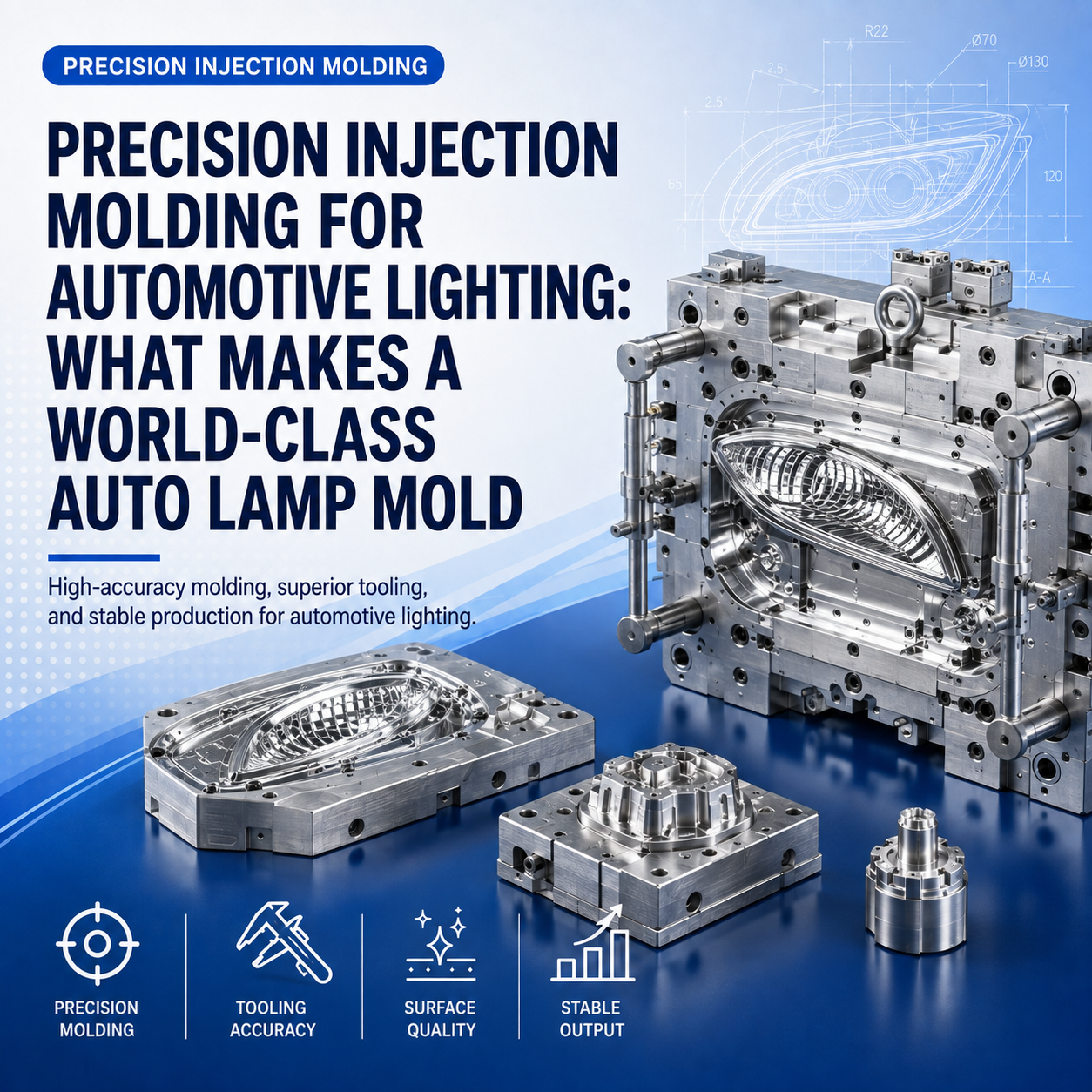
Let me be straight with you. If you're manufacturing auto lamp molds — or sourcing from someone who does — you're operating in one of the most demanding corners of the injection molding industry. And I don't say that lightly.
The global market for automotive lighting molds was estimated at USD 2.85 billion in 2024 and is projected to grow at a CAGR of 6.75%-. That's a serious market. But here's the thing: growth attracts competition, and competition separates the shops that can actually deliver from the ones that talk a good game.
I've spent enough years around moldmaking to know that auto lamp molds aren't like other injection molds. The tolerances are tighter. The optical surfaces are unforgiving. The cycle times are longer. And the cost of getting it wrong? A single defective mold can scrap thousands of parts before anyone notices.
So let's talk about what actually matters when you're manufacturing — or specifying — high-precision auto lamp molds.
Table of Contents
Why Auto Lamp Molds Are Different
The Precision Imperative: Tolerances That Matter
Mold Steel: The Foundation of Tool Life
2K Molding: The Game-Changer
Quality Control: Catching Problems Before They Cost You
Case Study: From 0.02mm to 0.01mm
Auto Lamp Mold Manufacturing: At-a-Glance Reference
FAQ
Final Thoughts
Why Auto Lamp Molds Are Different
Let's start with the obvious. A headlight isn't just a plastic housing. It's an optical system.
The mold cavity that forms the reflector surface needs to be flawless — no tool marks, no scratches, no microscopic imperfections that will distort the light beam. The lens needs optical clarity that soda-lime glass can't match and dimensional stability that only polycarbonate can deliver. The housing needs structural integrity and precise mounting points that align with the vehicle's body panels.
Every innovation in headlight design challenges mold engineering to its extremes-. LED proliferation, adaptive lighting, and the shift toward thinner, more aerodynamic designs all push moldmakers to deliver higher precision with shorter lead times-.
And here's the kicker: approximately 70% of automotive lighting mold projects experience delays when attempting to combine optical performance with textured surfaces on the same cavity surface-. That's not a niche problem — that's the majority of projects.
The Precision Imperative: Tolerances That Matter
Here's where auto lamp molds separate from the pack.
Cavity and core surface accuracy often demands ≤ ±0.01mm tolerances — equivalent to controlling a grain of rice on a football field-. Deviations at that scale cause optical distortion or structural flaws. A 0.1mm error can render a complete product scrap-.
For optical surfaces — the lens cavity and reflector cavity — the requirements are even more aggressive. The cavity surface needs to reach a mirror level, typically Ra < 0.05μm, with no defects such as weld lines, shrinkage marks, or flow lines-. The accuracy between the optical surfaces and their corresponding mold cavities must be controlled within ±0.01 to 0.05mm-.
Some manufacturers have pushed even further. One Chinese moldmaker improved light guide mold precision from 0.02mm to 0.01mm — roughly one-seventh the thickness of a human hair-. At that level, you're not machining steel anymore. You're sculpting it.
The production environment matters too. Top-tier manufacturers maintain 24/7 climate-controlled workshops at 25°C and 40–60% humidity to suppress thermal expansion and contraction of materials-. Without that, a 1°C temperature swing can push a precision-machined cavity out of tolerance.
Mold Steel: The Foundation of Tool Life
You can't hold 0.01mm tolerances with cheap steel. Period.
Auto lamp molds typically use high-hardness tool steels that balance wear resistance, toughness, and machinability-. The material choices are specific to the application:
S136-OPT is the go-to for optical surfaces — hardness HRC 45–50, excellent corrosion resistance, and the ability to take a mirror polish-.
718H is common for core and cavity components — hardness 35–40 HRC, good machinability, and sufficient wear resistance for production runs-.
NAK80 is pre-hardened to 38–42 HRC and requires no heat treatment, allowing direct mold manufacturing-.
D2 tool steel offers high wear resistance and the ability to hold sharp edges for intricate designs-.
For demanding applications, S136/H13 steel undergoes heat treatment to 50–55 HRC, resisting wear from abrasive resins-. Service life for high-quality molds typically ranges from 300,000 to 500,000+ cycles before refurbishment is needed-.
The trade-off is machining difficulty. Hardened steel is harder to cut, which means specialized tooling, slower feeds, and higher costs. But the alternative — using softer steel and accepting shorter tool life — rarely makes economic sense for high-volume automotive programs.
2K Molding: The Game-Changer
If there's one technology that's reshaping auto lamp mold manufacturing, it's 2K (two-shot) injection molding.
A 2K mold allows two different materials — or two colors of the same material — to be molded in a single cycle. For automotive lighting, this means you can mold the clear lens and the opaque housing together in one operation, eliminating assembly steps and improving seal integrity.
2K precision mold technology reduces cycle time by 35% compared to traditional assembly methods-. That's not a marginal improvement — that's a game-changer for high-volume production.
The "2K" refers to two-component injection molding, where the mold rotates or slides to present the first-shot component to a second injection unit-. The result is a single part with two materials, no assembly required.
But 2K molds are significantly more complex than standard injection molds. They require rotating or sliding cores, precise alignment between shots, and careful management of material compatibility. The mold design has to account for the thermal and flow characteristics of both materials simultaneously.
Quality Control: Catching Problems Before They Cost You
Precision machining is only half the battle. The other half is knowing whether you hit the target.
For auto lamp molds, quality control starts with Moldflow simulation — CAE analysis that predicts filling patterns, weld line locations, air traps, and warpage before any steel is cut-. This is non-negotiable for complex optical parts.
During machining, CMM (coordinate measuring machine) inspection verifies that every cavity surface is within tolerance. For optical surfaces, surface profilometry measures roughness at the nanometer scale.
During mold trials, real parts are molded and inspected — not just for dimensions, but for optical performance. A reflector cavity that looks perfect to the naked eye can still produce a light beam that's out of specification.
The best mold shops don't wait until the mold is finished to start quality control. They build inspection checkpoints into every stage of manufacturing — from steel receipt to final assembly.
Case Study: From 0.02mm to 0.01mm
Let me give you a real example of what precision improvement looks like.
A Chinese mold manufacturer — Saihao Mold — invested heavily in R&D, dedicating over 5% of annual revenue to process improvement-. Their focus? Light guide molds for automotive lighting.
The challenge was straightforward: the light guide needed to deliver uniform illumination across its entire surface. Any deviation in the mold cavity — even a few microns — would create bright spots or dark zones in the finished light guide.
Their first-generation molds held ±0.02mm precision. That was good — but not good enough for premium OEMs. The solution involved custom tooling fixtures and advanced cutting technology that pushed precision to ±0.01mm — roughly one-seventh the thickness of a human hair-.
The result? They perfected the light guide uniformity requirement for high-end automotive customers and secured long-term supply agreements.
The lesson? In auto lamp molds, precision isn't a one-time achievement. It's a continuous improvement process. And the companies that invest in the capability — not just the capacity — are the ones that win the premium work.
Auto Lamp Mold Manufacturing: At-a-Glance Reference
Parameter | Standard Mold | Auto Lamp Mold |
|---|---|---|
Typical Tolerance | ±0.05mm | ±0.01mm or better |
Optical Surface Roughness | Not applicable | Ra < 0.05μm (mirror finish) |
Typical Steel | P20, 718 | S136-OPT, NAK80, D2, H13 |
Hardness | 30–35 HRC | 38–55 HRC |
Tool Life | 100,000–300,000 cycles | 300,000–500,000+ cycles |
Mold Type | Single-shot | Often 2K (two-shot) |
Simulation | Optional | Required (Moldflow) |
Production Environment | Standard workshop | Climate-controlled (25°C, 40–60% humidity) |
FAQ
Q: What's the difference between a standard injection mold and an auto lamp mold?
Auto lamp molds demand significantly higher precision — ±0.01mm versus ±0.05mm for standard molds. They also require optical-quality surface finishes (Ra < 0.05μm) , specialized steel grades, and often 2K (two-shot) capability. The production environment is also more controlled — climate-controlled workshops are standard for high-end lamp mold manufacturing.
Q: How long should an auto lamp mold last?
A high-quality auto lamp mold should deliver 300,000 to 500,000+ cycles before requiring major refurbishment-. Tool life depends on the steel grade, the material being molded (filled resins are more abrasive), and the maintenance schedule.
Q: Why is 2K molding important for automotive lighting?
2K molding allows two materials — or two colors — to be molded in a single cycle. For lighting, that means molding the clear lens and the opaque housing together, eliminating assembly steps, improving seal integrity, and reducing cycle time by up to 35%-.
Q: What's the biggest challenge in auto lamp mold manufacturing?
The combination of optical performance and textured surfaces on the same cavity surface causes approximately 70% of projects to experience delays-. Managing the conflicting requirements — mirror-finish optical surfaces adjacent to textured cosmetic surfaces — pushes moldmakers to their limits.
Final Thoughts
Here's what I've learned. Auto lamp molds aren't just another injection mold. They're precision instruments that determine whether a vehicle's lighting system performs to specification — or fails in the field.
The market is growing — 6.75% CAGR through the forecast period-. The technology is advancing — 2K molding, conformal cooling, and advanced simulation are becoming standard. And the precision requirements are only getting tighter — ±0.01mm tolerances are now the baseline, not the aspiration.
The manufacturers who succeed in this space don't treat precision as a cost. They treat it as a capability. They invest in the steel, the machining, the simulation, and the quality control systems that deliver consistent results. They maintain climate-controlled workshops. They push their tool life to 500,000 cycles. And they keep improving — from 0.02mm to 0.01mm and beyond.
If you're manufacturing auto lamp molds — or sourcing them — the question isn't whether you can meet the spec today. It's whether you can meet the spec tomorrow, when the tolerances get tighter and the lead times get shorter.