August 11, 2026
Advanced Optical Design: Core Advantage of Auto Lamp Mould Manufacturing
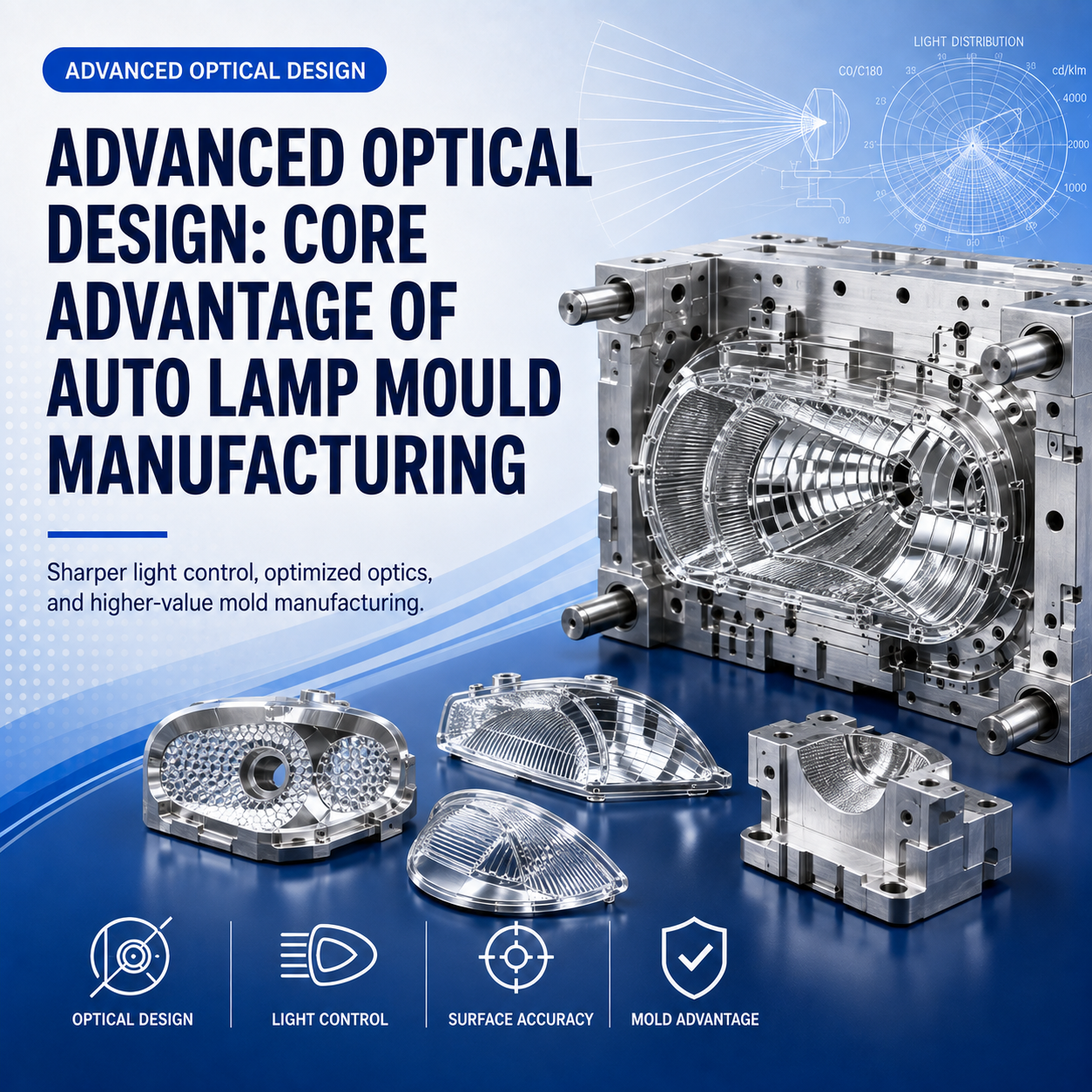
Table of Contents
1. Introduction
2. What Is Optical Design for Auto Lamp Moulds
3. Key Points of Advanced Optical Design in Mould Production
4. Typical Optical Defects of Auto Lamp Moulds & Solutions
5. Data Comparison: Ordinary Optical Design VS Advanced Optical Design
6. How Advanced Optical Design Improves Lamp Product Performance
7. Conclusion
8. Industry FAQ
1. Introduction
Auto lamps are vital functional and appearance components of vehicles. Lighting effect, light uniformity and appearance texture largely depend on the quality of auto lamp moulds.
In the whole auto lamp mould manufacturing chain, optical design is no longer an auxiliary link. It has become the core competitive advantage for professional mould factories.
Many manufacturers only focus on mould structure and machining accuracy. They ignore optical simulation and surface optical texture design, which leads to unqualified light distribution after mass production.
This article explains the value of advanced optical design in auto lamp mould manufacturing. It sorts out common optical defects and optimization methods, combining industry test data for reference.
Core Industry Keywords: auto lamp mould, automotive lighting mould, advanced optical design, light distribution design, optical texture, auto lamp lens mould, reflector mould
2. What Is Optical Design for Auto Lamp Moulds
2.1 Scope of Auto Lamp Optical Design
Auto lamp mould optical design mainly covers reflector optical surface, lens microstructure, light guide strip texture and light distribution matching design.
Every micro structure on the mould surface will directly change the light path of LED light source. Small deviations will cause light spots, dark areas or glare risks.
2.2 The Connection Between Optical Design and Mould Machining
Optical design outputs precise 3D optical surfaces. Mould processing needs to reproduce these micro structures accurately by high-precision CNC and polishing.
If optical simulation data cannot be perfectly matched with mould machining standards, the final lamp cannot meet national automotive lighting regulations.
3. Key Points of Advanced Optical Design in Mould Production
3.1 Pre-production Optical Simulation
Advanced optical design starts before mould machining. Engineers complete ray tracing simulation to check light distribution, illumination range and glare value.
Adjust optical curved surface parameters in digital model stage. It avoids large-scale mould modification after trial sample production and saves development cycle.
3.2 Micro-structure Design for Optical Surfaces
Lens and light guide moulds require lots of tiny optical textures. Advanced design optimizes texture arrangement, density and radian according to lighting requirements.
Uniform micro structure ensures soft light output and eliminates local bright spots on lamp surface.
3.3 Coordination Between Optical Surface and Demoulding Structure
A common mistake in ordinary design: optical curve is perfect in simulation, but leads to demould scratches.
Advanced optical design takes demoulding angle, ejection position and polishing process into full consideration. It balances optical performance and mould manufacturability.
4. Typical Optical Defects of Auto Lamp Moulds & Solutions
4.1 Uneven Light Brightness
Causes: Unreasonable optical surface radian, inconsistent mould polishing precision, deformed optical micro structure after injection.
Solutions: Re-optimize optical simulation model; unify ultra-precision polishing standard; control mould temperature to reduce plastic shrinkage deviation.
4.2 Obvious Bright Spots and Dark Zones
Causes: Discontinuous optical curved surface, error on reflector mould surface, mismatching between light source position and optical design.
Solutions: Revise local optical surface; carry out 3D scanning inspection on mould optical surface; reserve adjustable installation space for light source bracket.
4.3 Excessive Glare Not Meeting Regulations
Causes: Lack of anti-glare optical partitioning design; excessive deviation of optical surface during mould processing.
Solutions: Add anti-glare structure in early optical design; set stricter tolerance standard for key optical mould surfaces.
5. Data Comparison: Ordinary Optical Design VS Advanced Optical Design
The table below shows actual test data of auto lamp products produced by different optical design schemes.
表格
Inspection Item | Ordinary Optical Design | Advanced Optical Design | National Automotive Lighting Standard |
Light uniformity | 68% | 92% | ≥80% |
Glare test value | Exceed limit | Within qualified range | Limited maximum value |
First trial pass rate of mould sample | 57% | 89% | — |
Mould modification times in development | 3~6 times | 0~2 times | — |
Service life stability of optical surface | Obvious light decay after 80k shots | Stable performance over 150k shots | — |
From the comparison data, advanced optical design greatly improves the one-time success rate of auto lamp mould development. It reduces rework cost and guarantees long-term stable lighting performance of finished lamps.
6. How Advanced Optical Design Improves Lamp Product Performance
Advanced optical design realizes accurate light path control. The finished auto lamp can reach ideal illumination distance and width without increasing LED power.
Reasonable optical texture also improves the exterior visual effect. The lamp looks more delicate when turned off, which helps vehicle brand upgrade appearance competitiveness.
For mass production, mature optical design reduces the risk of batch unqualified lighting parameters. It helps auto part suppliers pass vehicle manufacturer access test smoothly.
7. Conclusion
Auto lamp mould manufacturing is a cross-field work combining optical engineering, mould technology and plastic injection process.
Advanced optical design is not only a design step, but the core advantage to distinguish high-quality auto lamp mould manufacturers from ordinary suppliers.
Enterprises that integrate optical simulation, high-precision machining and mould structure optimization can better meet the increasingly strict requirements of new energy vehicle lighting systems.
8. Industry FAQ
Q1: Can optical defects of auto lamps be solved only by adjusting injection parameters? A: Most optical problems root in mould optical surface design and machining. Injection parameters can only make slight adjustment. Fundamental improvement needs to optimize optical design and mould surface.
Q2: How long does advanced optical design take in auto lamp mould project? A: Normally optical simulation and scheme optimization take 7~15 working days before formal mould machining. Sufficient early-stage design greatly shortens overall project cycle.
Q3: Are reflector mould and lens mould using the same optical design logic? A: No. Reflector relies on reflection light path, while lens uses refraction. They need independent optical simulation and different micro-structure layout.
Q4: Will advanced optical design largely raise mould cost? A: Early design cost rises slightly, but it cuts expensive mould rework expense. From the whole project cycle, it brings better comprehensive economic benefit.
Q5: What equipment is required to process moulds with high-precision optical surfaces? A: Need ultra-precision CNC machine, optical surface measuring instrument, high-precision 3D scanner and professional optical simulation software.